Introduction
Mental health treatment has evolved significantly over the last decade. While medications and psychotherapy remain the foundation of care, many patients continue to struggle despite trying multiple treatments.
This is where Transcranial Magnetic Stimulation (TMS) Therapy is transforming neurological and psychiatric care.
Initially recognized as an effective treatment for depression, TMS is now being explored for a wider range of conditions including Obsessive-Compulsive Disorder (OCD), anxiety disorders, PTSD, chronic pain syndromes, and cognitive rehabilitation. Recent advancements in neuromodulation are making TMS more precise, personalized, and effective than ever before.
What is TMS Therapy?
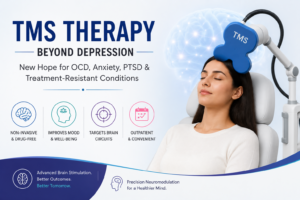
Transcranial Magnetic Stimulation (TMS) is a non-invasive brain stimulation therapy that uses magnetic pulses to activate specific areas of the brain involved in mood regulation, emotional processing, and cognitive function.
Unlike surgery or invasive procedures:
- No anesthesia is required
- No hospitalization is needed
- No recovery time is necessary
- Patients can resume daily activities immediately after treatment
TMS is considered a safe and well-tolerated treatment option for patients who have not responded adequately to conventional therapies.
Why is TMS Gaining Attention in 2026?
The latest trend in neuromodulation is moving beyond symptom control toward targeted brain circuit modulation.
Advanced forms of TMS now include:
Theta Burst Stimulation (TBS)
A faster version of TMS that delivers treatment in just a few minutes while maintaining effectiveness.
Deep TMS
Deep TMS targets broader and deeper brain networks and has received regulatory clearance for conditions such as OCD and treatment-resistant depression.
Accelerated TMS Protocols
New accelerated treatment protocols deliver multiple sessions over a shorter duration, potentially helping patients experience improvement more rapidly.
TMS for Obsessive-Compulsive Disorder (OCD)
One of the most significant developments in recent years has been the use of TMS for OCD.
Research suggests that TMS can target specific brain circuits involved in repetitive thoughts and compulsive behaviors. Studies have demonstrated meaningful symptom reduction in many patients who previously failed medications and psychotherapy.
Patients with OCD may experience:
- Reduced intrusive thoughts
- Better impulse control
- Improved daily functioning
- Enhanced response to behavioral therapy
TMS and Anxiety Disorders
Anxiety disorders affect millions of people worldwide.
Emerging evidence suggests TMS may help regulate overactive brain networks associated with excessive worry, fear, and emotional dysregulation. Researchers continue to investigate its role in generalized anxiety disorder and related conditions.
TMS for PTSD: A New Frontier
Recent studies have shown promising results for TMS in Post-Traumatic Stress Disorder (PTSD).
Advanced MRI-guided TMS approaches have demonstrated substantial improvements in PTSD symptoms by precisely targeting brain regions involved in fear processing and emotional regulation.
This development may offer hope for individuals who have struggled with long-standing trauma-related symptoms.
TMS for Treatment-Resistant Depression
Treatment-Resistant Depression (TRD) remains the most established indication for TMS.
For patients who do not achieve adequate relief from antidepressants, TMS offers a non-drug alternative that directly targets dysfunctional brain circuits involved in mood regulation. Studies consistently demonstrate significant response and remission rates among suitable candidates.
Benefits of TMS Therapy
- Non-invasive treatment
- No surgery
- No anesthesia
- Minimal side effects
- No memory impairment
- Outpatient procedure
- Can be combined with medications and psychotherapy
- Scientifically validated for multiple conditions
Who May Benefit From TMS?
You may be a suitable candidate if you:
- Have depression that has not responded to medications
- Struggle with OCD symptoms despite treatment
- Experience persistent anxiety symptoms
- Have PTSD or trauma-related disorders
- Prefer non-invasive treatment options
- Cannot tolerate medication side effects
A detailed neurological and psychiatric evaluation is essential before considering TMS therapy.
The Future of Brain Stimulation Therapy
The future of TMS lies in precision medicine.
Researchers are developing neuronavigation-guided, AI-assisted, and personalized TMS protocols that can target specific brain networks with greater accuracy. These advances may improve outcomes and expand treatment options for a wider range of neurological and psychiatric conditions.
Conclusion
TMS therapy has evolved far beyond its original role in treating depression. In 2026, it represents one of the most exciting developments in neurology and mental health, offering new possibilities for patients with OCD, anxiety, PTSD, and treatment-resistant depression.
As research continues to advance, TMS is poised to become an increasingly important component of personalized brain health and mental wellness strategies.
For individuals seeking innovative, evidence-based, non-invasive treatment options, TMS therapy may offer a path toward improved quality of life and lasting symptom relief.